
GOOGLE UPDATES
The Google Timeline: Why Crawling, Indexing & Recovery Take Longer Than You Think
SEO has always had one frustrating answer to questions around crawling, indexing and recovery: "It depends." But at Google Search Central Live Deep Dive Europe 2026, Google gave SEOs something more useful to work with — actual timing ranges.
Written & Reviewed by Vijayraj Nadar
Oct 6, 2026 • 10 min read
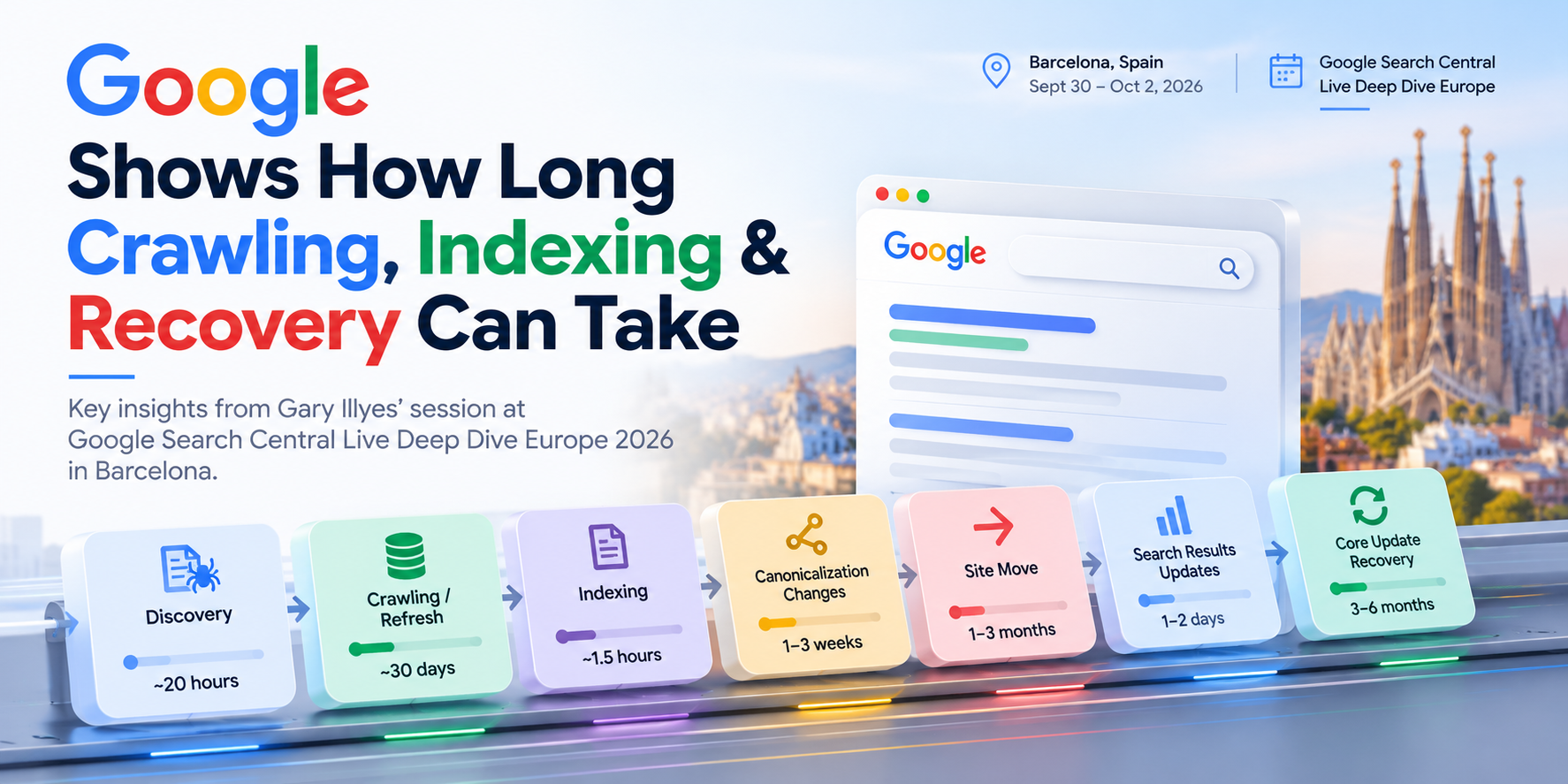
Key Takeaways
- Google can typically discover a new URL in around 20 hours, while refreshing an already-known URL was shown at around 30 days.
- Not every delay means something is broken. Sitemap processing, indexing, canonical changes and site moves can all have very different processing timelines.
- Site moves can take 1–3 months typically, while slower cases can extend from six months to a year or more.
- Core update recovery can take 3–6 months, with slower recovery potentially taking six months to a year and sometimes requiring the next core update.
- Google's processes are connected. A delay in crawling or another early stage can carry forward into indexing, canonicalization and ultimately what appears in Search.
5 Key Highlights
- Google can typically discover a new URL in around 20 hours, while refreshing an already-known URL was shown at around 30 days.
- Not every delay means something is broken. Sitemap processing, indexing, canonical changes and site moves can all have very different processing timelines.
- Site moves can take 1–3 months typically, while slower cases can extend from six months to a year or more.
- Core update recovery can take 3–6 months, with slower recovery potentially taking six months to a year and sometimes requiring the next core update.
- Google's processes are connected. A delay in crawling or another early stage can carry forward into indexing, canonicalization and ultimately what appears in Search.
- These should be treated as reference ranges, not Google deadlines or SLAs.
Google Search Central Live Deep Dive Europe 2026
- Google Search Central Live Deep Dive Europe took place at Hotel Catalonia Barcelona Plaza in Barcelona, Spain, from September 30 to October 2, 2026.
- The three-day conference was the first European edition of Google's technical Deep Dive format, bringing together SEO professionals, site owners, Googlers and community speakers.
- Speakers included John Mueller, Gary Illyes, Martin Splitt, Cherry Prommawin, John Campbell, along with other community speakers.
- The event was free and application-based, conducted entirely in English, with technical walkthroughs, lightning talks and 1:1 poster sessions.
What Google Covered Across the Three Days
- The agenda almost followed the journey of a URL through Google Search.
- Day 1 — September 30: Discovery, crawling, foundational Search concepts and using Google Search Console to diagnose issues.
- Day 2 — October 1: Indexing, rendering, duplication, canonicalization, international SEO and the role of AI in indexing.
- Day 3 — October 2: Serving, ranking, AI-powered Search features, Google Trends and timing ranges for crawling, indexing and recovery.
- The event covered a wide range of topics, from foundational SEO concepts to AI-powered Search.
- But one thing from Gary Illyes' Day 3 session particularly stood out: Google put timelines against Search processes.
Google Put Timelines Against Search Processes
- Gary Illyes shared timing ranges covering crawling, indexing, site moves and changes appearing in Search.
- What made this session particularly valuable was the distinction between typical and slower-case scenarios. Rather than giving a single answer to questions like "How long does crawling take?" Google acknowledged that the answer depends on multiple factors — and they showed both the optimistic case and the worst-case timeline.
- The ranges covered the full lifecycle of a URL in Google's system: from initial discovery through crawling, indexing, rendering, canonicalization, and finally appearing in Search results.
- One critical insight: these processes aren't independent. A delay at one stage cascades forward. If Google is slow to crawl a page, that affects when it can be indexed. If indexing takes longer, that affects when changes appear in Search results. Understanding this chain is essential for diagnosing why an SEO change hasn't taken effect yet.
- This is why the timing ranges matter so much to practitioners. When you make a change to your website and it hasn't appeared in Search yet, the natural reaction is to panic and make more changes. But with these reference points, SEO teams can now distinguish between normal processing delays and actual problems that require investigation.
- The ranges essentially gave the SEO community a framework for patience — and permission to wait, rather than constantly adjust and test.
Visual Recap of Timing Ranges
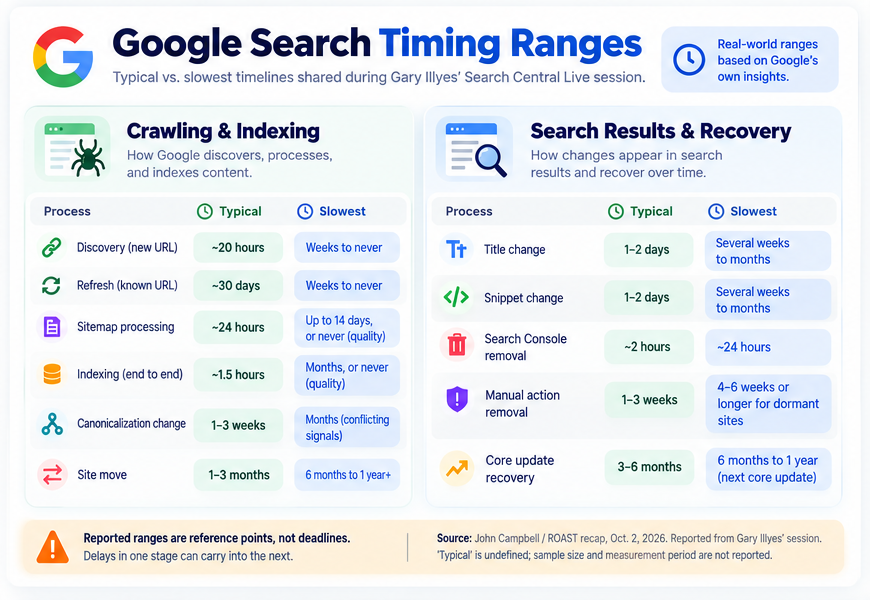
- Below is the visual recap of the timing ranges discussed during the session:
Crawling & Indexing Ranges
- According to John Campbell's recap of the session, Google typically takes around 20 hours to discover a new URL. For a URL Google already knows, the typical refresh time shown was around 30 days.
- That difference itself is interesting because we often talk about "Google crawling a page" as though it were one predictable process. It isn't. Discovery and recrawling can operate on very different timelines.
- The same applies to site migrations. Google's
- site-move documentation
- says that for small and medium-sized websites, most pages typically take a few weeks to move, while larger websites can take longer.
- Canonicalization can also require patience. Google's
- canonicalization troubleshooting guide
- notes that pages may remain within a duplicate cluster for up to two weeks after content fixes. This detail was
- added by Google in July
- .
- So when a canonical change doesn't reflect immediately, repeatedly changing the implementation may sometimes create more confusion rather than solving the original problem. Hence, first question should be: Has Google had enough time to process the change?
Search Results & Recovery
- The ranges become even more interesting when we move from crawling and indexing to what users actually see in Search.
- According to the attendee recap, title and snippet changes typically take one to two days to appear.
- In slower cases, however, they can take several weeks or even months.
- A Search Console removal request was listed at around two hours typically, with approximately 24 hours in the slower case.
- Manual action recovery is a much longer process. The typical range shown was one to two weeks, while slower cases could take four to six weeks — or longer for dormant sites.
Core Update Recovery: 3–6 Months
- The core update timeline refers to recovery after making changes, not how long the core update itself takes to roll out. That distinction is important. According to the recap, the typical recovery range shown was around three to six months.
- The slower range? Six months to one year, with the table referencing the next core update.
- This also lines up with Google's broader guidance. Google's
- documentation on core updates
- explains that some improvements can begin showing effects within a few days, while assessing an overall site-level improvement may take several months.
- And if nothing changes after several months, the site may need to wait until a future core update before the full impact becomes visible.
- So a site making substantial improvements after being affected by a core update shouldn't necessarily expect rankings to return the following week.
Why These Timelines Matter for SEO Teams
- For many people in the industry, the biggest value of these numbers isn't predicting exactly when Google will do something; rather it's knowing when not to panic.
- SEO teams constantly have to answer questions like: Why hasn't Google picked up the new title? Why is the old canonical still showing? We migrated the site. Why haven't all the URLs moved? We fixed everything after the core update. Why haven't rankings recovered?
- Until now, the answer usually involved some variation of "give Google more time."
- These ranges give us a better reference point. If a title hasn't changed after two days, that doesn't automatically mean something is broken. If a canonical change hasn't settled immediately, it doesn't automatically mean the implementation has failed. And if a site migration is still settling after several weeks, that isn't necessarily abnormal either.
- At the same time, these ranges can also help us understand when something does deserve investigation. If a site move is still unresolved after three months, for example, you're already reaching the higher end of the typical range reported from the session. At that point, checking redirects, canonicals, internal links, sitemaps, crawl behaviour and other migration signals becomes much more important.
The Bigger Takeaway
- The most useful way to look at these numbers is not as Google giving us a timeline for SEO. They are reference points, not deadlines.
- "Typical" itself wasn't formally defined in the reported session, and we don't have a published sample size or measurement period behind these numbers. But they still give SEO teams something valuable: A framework for distinguishing normal processing time from a potential problem. Perhaps the most important point from Gary Illyes' session is that these timelines shouldn't always be viewed independently.
- Search is a chain of processes: Discovery → Crawling → Rendering → Indexing → Canonicalization → Serving
- If Google is delayed at an earlier stage, everything dependent on that stage can also be delayed. So the next time a Search change hasn't appeared yet, the question shouldn't immediately be: "Why isn't Google showing my change?"
- A better question might be: "Which stage is Google currently processing — and are we still within a reasonable timeframe?"
- That is a much more useful way to diagnose SEO problems.
RELATED ARTICLES

GOOGLE UPDATES
SERP Poisoning: Is Google Showing Misleading Search Results to Rank Trackers and AI Scrapers?
Nozzle analysed 27.5 million Google SERPs and found unusual ranking volatility. Explore SERP poisoning, AI scraping, rank tracking and SEO implications.
Oct 15, 2026 • 12 min readRead Article
GOOGLE UPDATES
Google's September 2026 Spam Update: What's Actually Happening?
Tracking SERP volatility and ranking changes from the September 2026 spam update—with observations based on actual data showing how local queries and aggregators are moving.
Sep 27, 2026 • 5 min readRead Article